Posts

METHODS ENGINEERING:ENGINEERING DESIGN

Image
4. ENGINEERING DESIGN After reviewing the job design guidelines from Section 2 and the information from Section 3, you can design alternatives. Remember the five steps of engineering design with the acronym DAMES: Define the problem, Analyze, Make search, Evaluate alternatives, and Specify and sell solution. See Table 22. 1. Define the problem broadly. Usually the designer is not given the problem but instead is confronted with the current solution. The current solution is not the problem but just one solution of among many possible solutions. The broad, detail-free problem statement should include the number of replications, the criteria, and the schedule. At this stage, putting in too much detail makes you start by defending your concept rather than opening minds (yours and your clients’) to new possibil ities. At this stage, the number of replications should be quite approximate (within ±500%). Criteria (see Section 2.1) usually are multiple (capital cost, operating cost, quali...

METHODS ENGINEERING:Within-Operation Analysis

Image
3.5. Within-Operation Analysis This section will discuss fish diagrams, decision structure tables, and checklists. 3.5.1. Fish Diagrams Fish diagrams graphically depict a multidimensional list. See Figures 20 and 21. Professor Ishikawa developed them while on a quality control project for Kawasaki Steel; they are the ‘‘cause’’ side of cause-and-effect diagrams. The diagram gives an easily understood overview of a problem. Start with the ‘‘effect’’ (a fishhead), a specific problem. Then add the ‘‘cause’’ (the fish body), composed of the backbone and other bones. A good diagram will have three or more levels of bones (backboneA, major bones, minor bones on the major bones). There are various strategies for defining the major bones. Consider the 4 M’s: manpower, machines, methods, materials. Or use the 4 P’s: policies, procedures, people, plant. Or be creative. Figures 20 and 21 were used at Bridgestone to reduce the variability of the viscosity of the splicing cement used in radial ...

METHODS ENGINEERING:GUIDELINES

Image
O VERVIEW Section 2 starts with some criteria for job design. The emphasis is on health and safety; due to progress in technology, every worker will supervise a number of slaves (machines). Section 2 then gives guidelines for organization of groups of workstations, the workstation itself, musculoskeletal disorders, fatigue, and error reduction. Section 3 discusses gathering and organizing information. After potential projects are prioritized, the existing situation can be recorded. The big picture (between-operations analysis) or the detailed picture (within-operation analysis) can then be analyzed. Section 4 discusses how to use the information to design. GUIDELINES This section discusses (1) criteria of job design, (2) organization of groups of workstations, (3) individual workstations, (4) musculoskeletal disorders, (5) fatigue, and (6) error reduction. 2.1. Criteria of Job Design Table 1 gives the six ergonomic criteria for job design: 1. Safety is first. A job des...

METHODS ENGINEERING:Searching for Solutions

Image
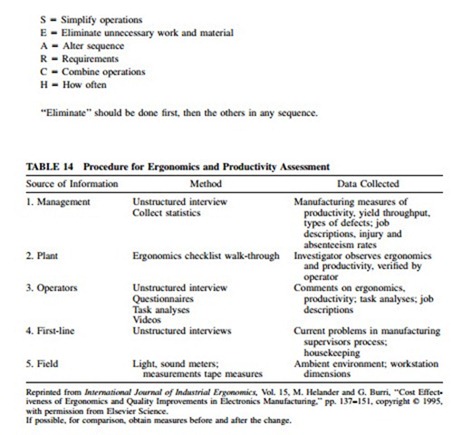
Searching for Solutions Table 14 shows the general procedure for an assessment. Also see Section 4 for the steps of engi- neering design. The typical sequence is (1) being informed by management that there is a problem, (2), (3), (4) getting information by observation and from the operators and supervisors, and (5) making measurements. Then propose a solution. Rather than depending on inspiration for the solution, most people prefer to follow a more systematic procedure, using tried-and-true techniques established by people who have previously worked on this type of problem. Searching for an alternative method can be done by following Kipling’s ‘‘six honest men’’ (who, what, why, when, where, and how), following checklists (see examples in Section 3.5), or using the acronym SEARCH, where: If possible, for comparison, obtain measures before and after the change. E = Eliminate unnecessary work and material. Four subcategories are (1) eliminate unneeded work, (2) eliminate work ...

METHODS ENGINEERING:GATHERING / ORGANIZING INFORMATION

Image
GATHERING / ORGANIZING INFORMATION This section will discuss What to study (Pareto), videotaping jobs, searching for solutions, between- operations analysis, and within-operation analysis. 3.1. What to Study (Pareto) Engineering time is a valuable resource; don’t waste time on unimportant problems. To check quickly whether a project is worth considering, calculate (1) savings / year if material cost is cut 10% and (2) savings / year if labor cost is cut 10%. The concept of the ‘‘insignificant many and the mighty few’’ (Pareto distribution) is shown in Figure 7. Cause ( x -axis) and effect ( y -axis) are not related linearly. The key concept is that the bulk of the problem (opportunity) is concentrated in a few items. Pareto diagrams are a special form of a histogram of frequency counts; the key is that the categories are put into order with the largest first and smallest last; then a cumulative curve is plotted. Therefore, using the Pareto concept, if your design concerns crime, ...